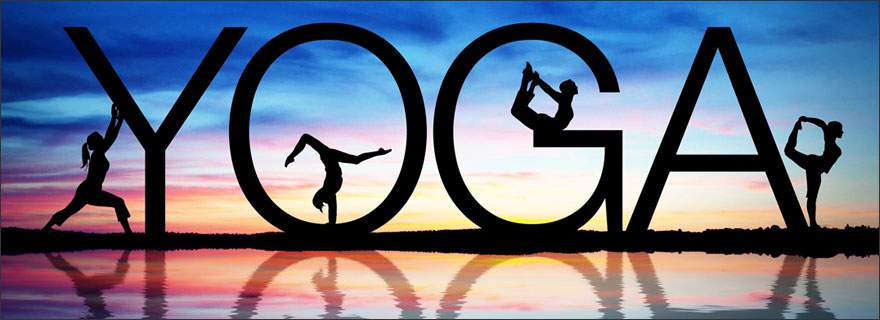
There are different paths (margas) of yoga that can be taken in order to reunite with the divine energy.
An active person can realize his divinity through work and duty (Karma),
A religious person through devotion (Bhakti),
An intellectual person through knowledge (Jnana), and
A meditative/reflective person through Raja Yoga.
The different types of yoga share some common elements.
Some focus more on breathing exercises and postures, whereas others focus more on spirituality.
Each type emphasizes a particular path that comprises a certain set of beliefs, practices, and rituals. The Yoga types constitute a ladder, from the “lowest” form of Hatha yoga, with its focus on physical postures and breathing techniques, to the “highest” form known as Raja yoga, or “union by mental mastery.”
Astrology of the Day | Tarot of the Day | Monthly horoscope | Tarot Monthly
The following are the various types of Yoga.
Hatha, Bhakti, Karma, Jnana, Raja, Tantra, Purna
Hatha Yoga, or Yoga of Vitality
Hatha Yoga is the foundation of all Yoga systems. Hatha Yoga is a preparation for higher Yogas.
“Ha” means “sun” and “tha” means “moon.”
Thus, Hatha Yoga refers to positive (sun) and negative (moon) currents in the system. These currents have to be balanced and mastered so that vital force (prana) can be regulated, the mind cleared and superconscious state be experienced. The ideal way to practice the Hatha Yoga poses (asanas) is to practice in a calm, meditative mood. Sit quietly for a few moments, then begin the series. This should be done slowly, with control and grace, all the while being inwardly aware as the body performs the various poses. Do not overdo the asanas or try to compete with others. Enjoy the asanas and take it easy.
Other Horoscopes
Free Daily Horoscope | Free Monthly Horoscope
Free Yearly Horoscope | Free Tarot 2022
Bhakti Yoga or Yoga of Love
Bhakti Yoga is the system in which love and devotion is emphasized.
Love of God and one’s complete surrender to God’s will is stressed in the Bhakti Yoga approach. Some people are naturally inclined by temperament to be devotional and to love God.
However, balance is strongly recommended: devotion should be balanced by reason, love should be balanced by understanding. There are no set ways to perform Bhakti yoga. Some people find that external aids can contribute to a devotional attitude: an altar used during prayer and meditation; pictures of saints to serve as inspiration; chanting or singing; use of mantra or even a simple devotional ceremony to aid in creating a mood as preparation for meditation. The best approach is the one which is found most useful in the long run. Singing the name of God aloud can elevate consciousness, clear the mind and even charge the environment with pure energy. For those who find it difficult to concentrate during meditation, and for whom the approach of calm discernment is too subtle, prayers and chanting can be of value.
Karma Yoga, or Yoga of Selfless Action
The message of Karma Yoga is
Working in harmony with the Power that runs the universe, not being egotistically motivated, having no compulsive desires relative to the future.
With the eradication of the compulsive desire, one is able to live in the present, while planning for the future, without being bound to it. Every reasonable desire carries within itself the motivating force for its fulfillment. The Yogic philosophy does not ask one to give up intelligent planning. It only aims at the renunciation of egotistic desire.
Jnana Yoga, or Yoga of Knowledge
The Jnana Yoga stresses the use of the mind to transcend the mind. It works with that part of the human mind which strives incessantly to know and understand.
It is multi-limbed, and its other limbs are detachment, self-discipline, longing for freedom, desire to hear the truth, reflection upon that truth, and meditation. The tradition of Jnana Yoga teaches that “Liberation is attained, not by works or ceremony, but by knowledge alone.”
Weekly Astro Horoscope | Weekly Love Horoscope | Weekly Career horoscope | Weekly Health Horoscope | Weekly Tarot Horoscope
Knowledge in this context is not belief or collected data; it is comprehension as a result of discernment and experience. The way of knowledge is for the special few who are prepared for steady examination and clear perception of the nature of consciousness. One who chooses this path studies the conclusions of the seers by reading the great scriptures and commentaries, then examines them in the light of his own intelligence and comes to his own realization. In deep meditation, he contemplates the characteristics of consciousness in manifestation and, by doing so, gains insight and perfect realization.
Raja Yoga, or The Highest Form of Yoga
“Raja” means “royal”. and Raja yoga is the royal path to Self-Realization by way of meditation.
Raja Yoga starts with the mind. Its goal is complete stilling of the mind, so that the light of the indwelling spirit may shine out. It makes use of asana and pranayama, and it is also considered by some as a name for Ashtanga Yoga. Raja Yoga meditation is the process whereby the practitioner concentrates upon one point in order to integrate discontinuous, diffused attention, thus holding his attention steady. All distractions are thus effectively closed out, and meditation proceeds.
Mantra Yoga
Mantra yoga means “union by voice or sound”. This form includes the rhythmic repetitions of specific sounds, or mantras. The practitioner repeats the syllable, word or phrase continually; sometimes for weeks, months or years on end. Certain syllables are believed to posses healing potential for specific purposes.
Tantra Yoga, or Kundalini yoga
A celibate approach to spiritual growth is quite common in many of the world’s religious traditions. Many yoga practices suggest that sexual involvement is a detriment to a greater development of self and hence should be avoided if possible. However, tantric yoga suggests that sexuality can be a very powerful force which can be harnessed for increased self-awareness.
Tantric yoga is unusual, in that it not only allows sexual feelings and contact, but uses sexual experience as a means to enlightenment. The Tantrics maintain that there is an enormous energy locked into sexuality, which, if released from the lower end of the spine, can flow up the spinal column to bring divine illumination to the brain.
They believe that within the interior of the spine, in a hollow region called the canalis centralis, there is an energy conduit called “sushumna”. Along this conduit, from the base of the perineum to the top of the head, flows the most powerful of all psychic energies, the Kundalini energy. On each side of the canal are two additional energy channels, one called “Ida” corresponding to the male, and the other the “Pingala” corresponding to the female. Ida begins at the right of the base of the spine and the Pingala begins at the left. These two psychic currents are said to coil upward like snakes around the spine, crossing the chakras (energy wheel centers of consciousness).
The Kundalini yogi’s lifelong tasks is to bring the focus of the Kundalini energy upward from the root chakra at the base of his spine to the crown chakra at the top of his head.
What does the Lord of Wealth Indicate in your Birth Chart? | Planets that make a Good Cricketer | Which direction is not good for Aquarium |
Once the yogi has achieved mastery of self, he is ready to join with a partner whose energies and spirit complement his own in such a way that together they form a “whole”.
The partners must first achieve a highly developed awareness within their being before they are ready to engage in tantric embrace. In the tantric lovemaking experience, known as “maithuna”, the lovers undergo a variety of meditations and rituals before they actually make physical contact. They maintain the spiritual link or bond throughout the lovemaking process. They visualize the flow of currents between them. In tantric yoga, the lovers do not try to achieve orgasm. In fact, they work hard not to have one.
They attempt to draw the forces of Kundalini energy upward through their bodies, thus releasing the power of the various chakras. This force transforms the yogi psychologically, changing his personality as the Kundalini reaches each succeeding chakra. The emphasis is not on the sexual release as an end in itself, but rather on sex as a channel through which the evolution of self may proceed. The goal of Tantra is the union of dynamic and static aspects of personality (shakti and shiva). It is quite different from practices that dwell on renunciation.
Purna Yoga, or Integral Yoga
This yoga attempts to integrate all aspects of action, wisdom, and peace into one yoga. It aims at an integration on three levels: Psychic integration, of the various facets of the self; Cosmic integration, of the aspects of the universe; and Existential integration, which comes when one fully realizes that the self and the universe are one
Article by: Jyotirvid Pawan Kumar